


Brake shoe spring: the core guarantee of heavy truck braking system
They play an indispensable role in the vehicle braking process.With the booming development of the logistics and transportation industry, heavy trucks are responsible for a large amount of cargo transportation. The quality of their braking performance is directly related to whether every trip on the road is safe.
Classification of brake shoe springs
-
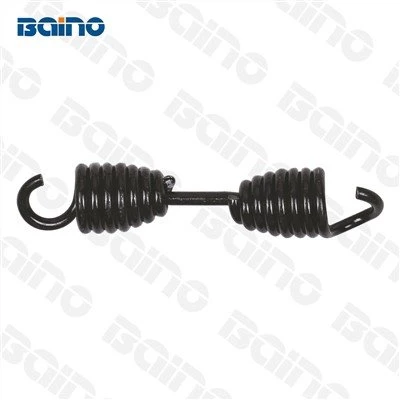
Brake shoe repair springs are mainly divided into two categories: compression springs and tension springs.
The compression spring has a spiral appearance. When squeezed by external force, the spring will be compressed and shortened, storing elastic potential energy, and quickly return to its original length after the external force disappears. In the brake system, it helps the brake shoe return to its position.
The tension spring mainly helps maintain the position of the brake components to ensure accurate and smooth braking action.They are usually made of high-strength metal materials such as carbon steel, stainless steel or alloy steel. These materials give the springs good elasticity and corrosion resistance, allowing them to maintain stable performance during long-term use.
Working principle of brake shoe springs
When the driver steps on the brake pedal, the piston or brake shoe in the brake system quickly fits tightly with the brake disc or brake drum under the strong hydraulic or mechanical force, and the vehicle is decelerated or stopped through huge friction. In this process, the brake shoe spring will be compressed or stretched accordingly due to the external force, storing elastic potential energy.
When the brake pedal is released, the energy stored in the spring is instantly released, and its strong elastic force drives the piston or brake shoe to quickly return to the initial position, prompting the brake pad to be completely separated from the brake disc or brake drum, making full preparations for the next braking operation and ensuring that the braking system of heavy trucks is always on standby.
At the same time, during long-distance transportation, reliable brake shoe springs can effectively reduce unnecessary friction between brake pads and brake discs or brake drums, reduce the degree of component wear, extend the service life of key components of the brake system, reduce the risk of vehicle downtime due to brake system failure during transportation, and ensure efficient and smooth logistics transportation.
What is the function of brake shoe springs?
1. Greatly improve the response speed of the brake system.
When a heavy truck faces an emergency and needs to brake immediately, the brake shoe spring can quickly push the brake components to move, so that the vehicle can generate braking force in the shortest time, effectively shorten the braking distance, and gain valuable reaction time for the driver, reducing the possibility of accidents.
2. Significantly reduce friction and wear between components. This not only extends the replacement cycle of components such as brake pads, brake discs, and brake drums, reduces maintenance costs, but also reduces the risk of reduced braking performance due to component wear, ensuring that heavy trucks always maintain a good braking state throughout the entire operating cycle.
3. It helps to maintain the stability of the vehicle during braking, effectively reduce the jitter and abnormal noise generated during braking, create a more comfortable and quiet driving environment for the driver, and reduce the fatigue caused by long-term driving.
Normally, the service life of brake shoe springs in heavy trucks is about 2-3 years, but the actual service life will be affected by many factors such as vehicle use frequency, road conditions and load conditions. Therefore, drivers need to regularly maintain and maintain them to ensure driving safety.
How to care and maintain?
1. Regularly check whether the brake shoe springs have abnormal signs such as deformation, breakage, and rust. Once the spring is found to be broken, it must be replaced with a new spring immediately to avoid brake failure and serious traffic accidents. If the spring has insufficient elasticity, it is necessary to further check whether there is deformation or fatigue. If so, it should be replaced in time.
When the driver finds that the brake pedal returns slowly or hears abnormal friction during braking, he should be highly vigilant. This is likely to be a signal of a brake shoe spring failure. The vehicle needs to be sent to a professional maintenance station for comprehensive inspection and repair in time.
2. Apply protective grease appropriately to prevent rust. When heavy trucks are parked for a long time, the brake shoe springs may also age and rust due to moisture, oxidation and other reasons.
3. When replacing the brake shoe spring, be sure to choose a product of reliable quality that fully matches the vehicle model and brake system. During the installation process, ensure that the spring is firmly installed without looseness or twisting. At the same time, strictly follow the technical specifications to determine the installation direction and position of the spring. After the installation is completed, the brake system must be fully debugged to ensure that the performance indicators of the brake system return to normal and the braking effect reaches the best state.


